We began this series with trust in ourselves. We moved to trust in others, and the risk kindness always carries. Last week, we looked at what happens once that trust breaks, and the difference between healthy caution and a closure that quietly stops kindness altogether. This final piece turns to the question that has been sitting underneath all three: once trust is gone, how does it come back.
The honest answer is that trust does not return through a single gesture, an apology, or a decision to simply try again. It comes back the same way it was built the first time. Slowly, through small and repeated proof. What is different this time is that kindness is not just the outcome of that process. It is the mechanism that drives it.
Why apology alone is not enough
An apology can open the door to repair, but it cannot walk through it alone. Words acknowledge that harm occurred. They do not, by themselves, demonstrate that the harm will not happen again. This is why an apology that is not followed by changed behavior tends to deepen distrust rather than resolve it. It teaches the person on the receiving end that words and actions can be separated, which is often the very lesson that damaged trust in the first place.
Rebuilding trust requires something slower and less satisfying than a single moment of accountability. It requires consistent, unremarkable acts of care, repeated over enough time that they stop looking like an effort to be forgiven and start looking like who someone actually is.
Kindness as evidence, not persuasion
This is where kindness does its real work in the rebuilding process. Not as an argument for why someone should be trusted again, but as evidence, offered patiently, without demanding that it be believed right away.
A person rebuilding trust through kindness does not get to control how quickly that kindness is received. Early on, it may be met with suspicion, tested, or simply not acknowledged at all. This is uncomfortable, but it is not a sign that the kindness is failing. It is a sign that trust is doing exactly what it should be doing: withholding belief until belief has been earned again.
The temptation, in this stage, is to perform kindness loudly, to make sure it is noticed and credited. Real rebuilding tends to look the opposite. Quiet, consistent, and largely unconcerned with whether it is being watched, because that is precisely the quality that was missing when trust broke in the first place.
What the person who was hurt is owed
Rebuilding trust is not only the responsibility of the person who broke it. The person who was hurt is owed patience of a different kind: the freedom to move slowly, to test, to remain guarded for longer than feels comfortable to the person waiting to be trusted again.
This is where the distinction from week three becomes practical rather than theoretical. Healthy caution, extended toward the specific person and situation involved, is not a failure to forgive. It is the responsible pace at which real trust gets rebuilt. Kindness toward someone who is still cautious does not mean pretending the caution is unnecessary. It means being consistent enough, for long enough, that the caution eventually has less to hold onto.
Bringing the series together
Across these four weeks, one idea has run underneath all of it: kindness and trust are not two separate qualities that happen to appear together. They depend on each other directly.
Self trust determines whether kindness can be offered freely, without being second guessed into anxiety. Trust in others determines whether kindness can be given at all, since every kind act carries some risk of disappointment. When trust breaks, kindness is usually the first thing withdrawn, because withdrawing it is how people protect themselves from being hurt again. And when trust is rebuilt, it is kindness, patient and repeated, that does the rebuilding.
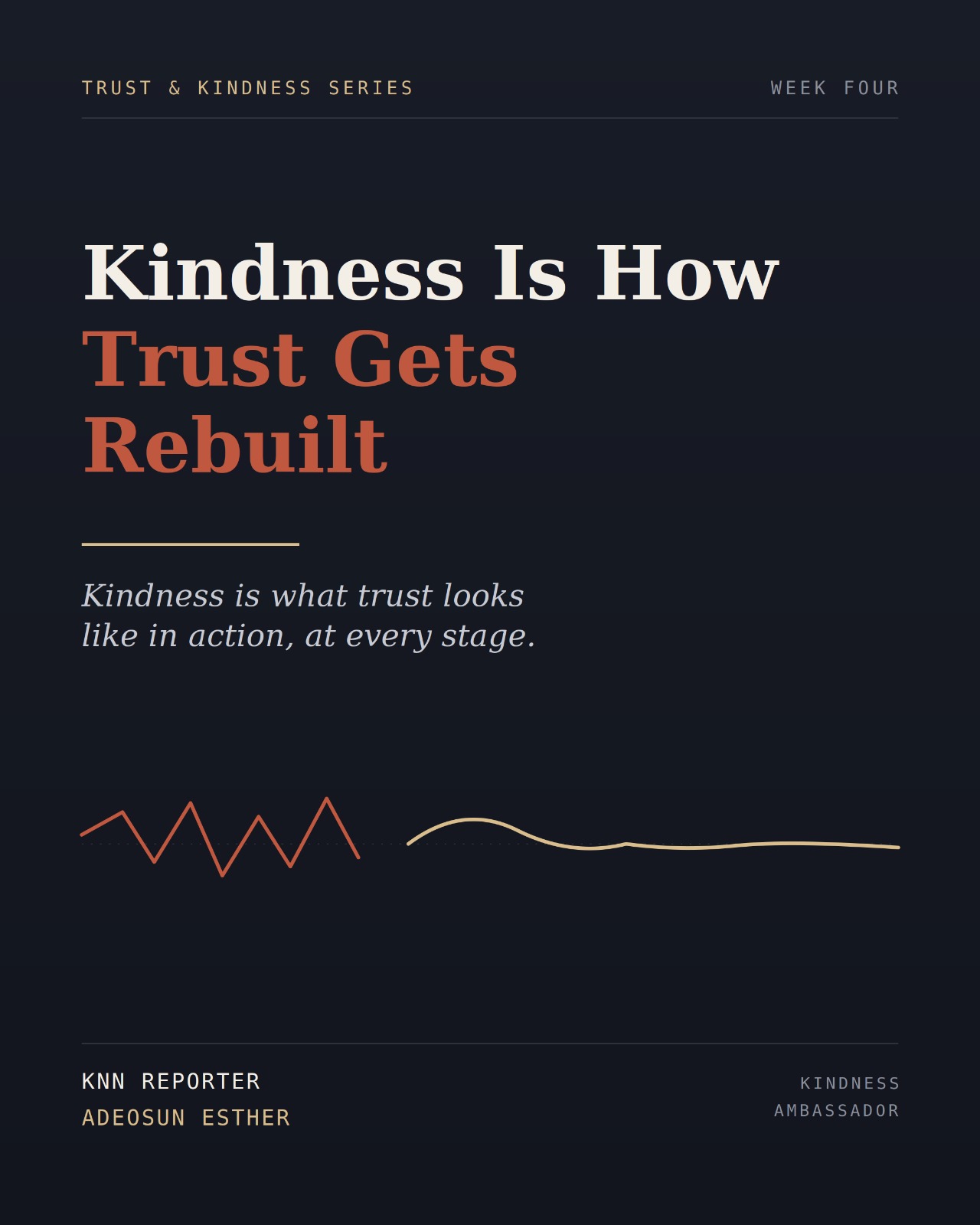
Kindness, in other words, is not simply a virtue that exists on its own. It is what trust looks like in action, at every stage: forming it, risking it, losing it, and slowly, carefully, earning it back.
This closes our four week series on trust as the foundation of kindness. Thank you for reading alongside us, from trusting ourselves, to trusting others, to what happens when trust breaks, to how kindness is what finally rebuilds it.