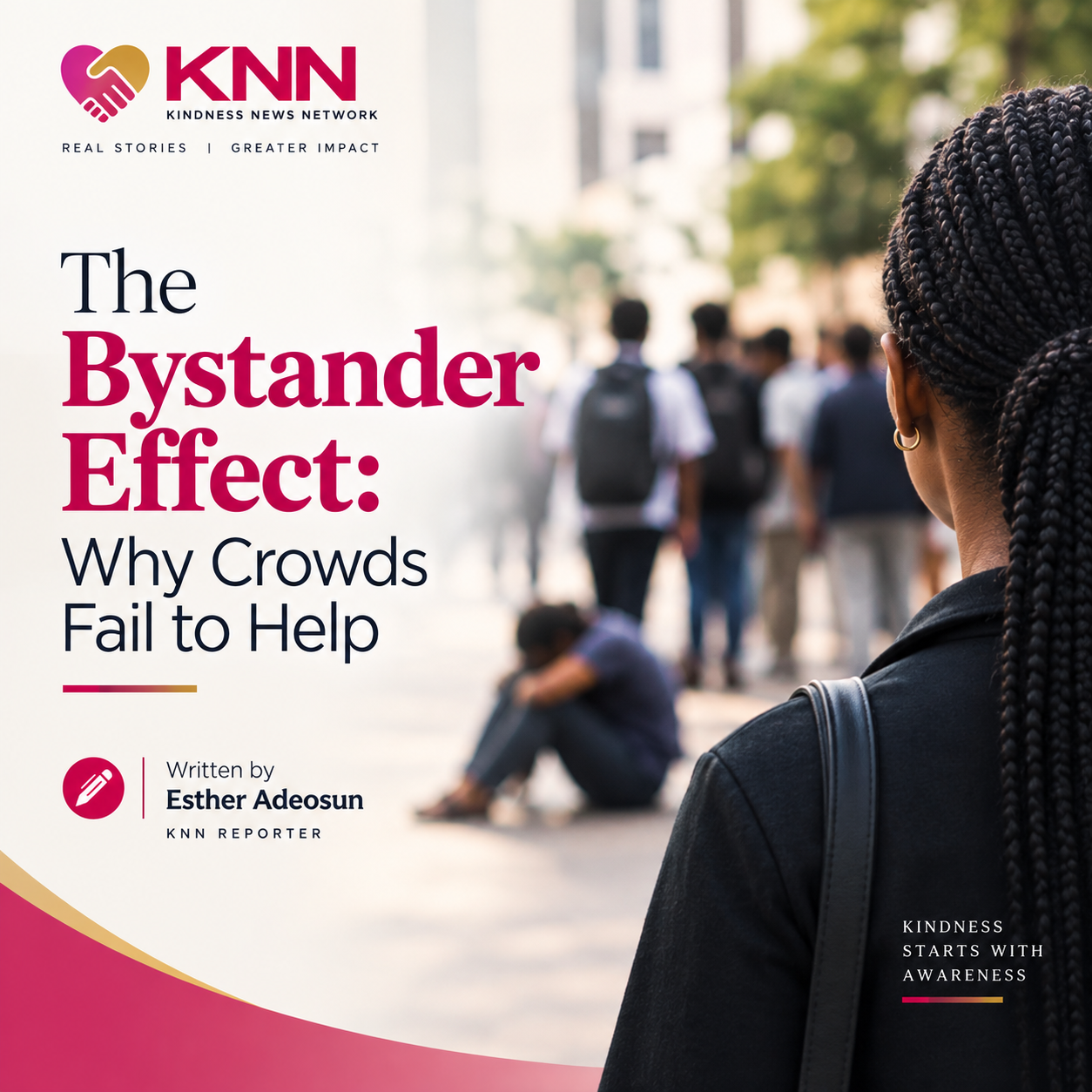

Over the past two weeks, we have tried to understand, without excusing, why a crowd might fail to help someone in crisis. The bystander effect explains hesitation. It explains silence. It explains the quiet, group-shaped logic that convinces each individual person that someone else will act. What it does not explain, on its own, is laughter.
There is a meaningful difference between failing to help and actively participating in someone’s suffering, and this week is about naming that difference clearly, because the two are often spoken about as if they were the same failure. They are not. One is a lapse. The other is a choice.
Two different failures
Hesitation is what happens when a person freezes, unsure whether to intervene, waiting for someone else to move first. It is a failure of nerve, often accompanied by guilt, sometimes even in the moment it is happening. Most people who hesitate in a crisis know, somewhere, that they should be doing something else.
Laughter, mockery, filming for entertainment rather than for evidence or help, these are not failures of nerve. They are decisions, made while fully present, to treat someone’s suffering as content rather than emergency. The person doing this has not frozen. They have chosen an interpretation of what they are watching, and that interpretation is entertainment.
This distinction matters because it changes what needs to be addressed. Hesitation can often be overcome with clearer information, a direct request for help, or a single person breaking from the crowd, as we discussed last week. Mockery requires something different: an honest look at how a person came to see someone else’s worst moment as a source of amusement in the first place.
How suffering gets turned into spectacle
Part of the answer lies in distance, even when that distance is only a few feet of physical space. Watching someone from outside their experience, without entering it, can create a strange psychological gap in which the person suffering starts to feel less like a person and more like an event unfolding for the benefit of whoever is watching. This is the same mechanism, in a much darker register, that allows people to watch tragedy unfold on a screen and feel entertained rather than moved. Proximity does not always close that gap. Sometimes it only changes the resolution of the image.
Group dynamics make this worse. Just as a crowd diffuses responsibility, it can also amplify a reaction once one person sets the tone. If the first audible response to a man in crisis is laughter, that laughter becomes, in the moment, the crowd’s shared emotional register. Others may join not because they independently find the situation funny, but because laughing along requires less social risk than being the one person who reacts with visible distress or concern. What began as one person’s cruelty can quickly become a performance the whole crowd is participating in, even among people who would never have started it themselves.
Why this deserves harder language than hesitation does
It is tempting, in trying to understand cruelty, to explain it into something softer than it is. We should resist that temptation here. A person who hesitates to help a stranger is caught in a psychological pattern worth understanding with compassion. A person who laughs at that same stranger’s dying moments has made a choice that understanding should not soften into forgiveness.
This is not a contradiction of the compassion we have tried to bring to this topic throughout the month. It is a recognition that compassion for the mechanisms behind human failure does not require withholding judgment from its worst expressions. Naming mockery as complicity, rather than as an unfortunate byproduct of crowd psychology, is part of taking the person who died seriously.
When the audience is no longer just the crowd
There is a version of this cruelty that has become harder to ignore, because it no longer happens only in the moment. Increasingly, people do not simply laugh at someone else’s misfortune and let it pass. They turn the camera on themselves while laughing, and share it, for an audience that was never present at all.
This changes something important about the psychology involved. Laughing within a crowd, as we discussed above, can be explained, though not excused, by social pressure and the diffusion of responsibility. Filming your own reaction and posting it removes that explanation almost entirely. There is no crowd setting the tone in that moment. There is a person, alone with a decision, choosing to preserve their amusement at someone else’s suffering and present it to others as something worth watching.
This is complicity with an audience built in. It asks other people, often strangers on a screen, to find the same thing funny, and it rewards that response with attention. Suffering, in this version, is not only witnessed without help. It is packaged, and the packaging itself becomes a bid for approval. That is a colder thing than a crowd’s laughter, because it requires no crowd at all. It only requires someone willing to imagine an audience for someone else’s worst moment, and to believe that audience will be pleased.
This deserves to be named clearly rather than folded into the broader idea of bystander cruelty. A person who laughs in a crowd is, in part, borrowing courage from the people around them. A person who records themselves laughing and shares it is not borrowing anything. They are creating something, deliberately, out of a stranger’s pain, and asking to be seen for it. Whatever compassion this series has tried to bring to understanding cruelty, this particular version asks for very little of it.
What might be happening internally
It is worth asking, carefully, what state of mind allows a person to do this, not to excuse it, but because understanding it is part of resisting it. Researchers who study cruelty and moral behaviour point to a few overlapping processes, and they rarely involve a person consciously deciding they enjoy someone else’s suffering. More often, they involve a series of smaller mental steps that make the suffering easier to look past.
One is moral disengagement, a term used to describe the ways people quietly excuse themselves from the usual standards they would apply to their own behaviour. This can look like deciding the person suffering somehow invited it, or that filming is harmless because it is only a reaction being shared, not the misfortune itself. Each of these steps is small, and each one makes the next easier, until a person can do something that would have troubled them a year earlier without much internal resistance at all.
Another is desensitisation, the gradual dulling of a person’s emotional response after repeated exposure to distressing content. For someone who has spent years scrolling past clips of accidents, fights, and other people’s worst moments, a stranger’s real suffering can start to register with the same emotional weight as content designed to entertain, because the two have been arriving through the same screen, in the same format, for a long time.
A third is the pull of attention itself. Platforms that reward engagement do not distinguish between admiration and shock. A clip of someone laughing at a stranger’s crisis can perform well precisely because it disturbs people, and disturbance keeps people watching and sharing. For someone motivated, consciously or not, by the reward of being seen, that incentive can quietly outweigh the discomfort of what is actually being filmed.
None of this describes every person who does this, and it is not offered as a diagnosis of anyone in particular. It is offered because a behaviour that seems, from the outside, like simple heartlessness is often closer to a series of ordinary psychological shortcuts, taken repeatedly, in an environment that rewards exactly the wrong response. That does not make it less serious. It means the fix has to include the environment doing the rewarding, not only the individuals caught inside it.
What this asks of anyone watching
If there is a practical lesson in this, it is one aimed less at explaining other people’s cruelty and more at guarding against the moment it might start to feel available to us. The gap between hesitation and mockery can open quickly in a crowd, especially once someone else has already crossed it. Recognising that gap while it is still small, in the first uncomfortable laugh, the first phone raised to film for the wrong reason, is far easier than trying to close it once an entire crowd has stepped through.
Where this leaves us
Watching and failing to help is a human weakness worth understanding. Watching and choosing to be entertained is something else, and calling it what it is matters, both for the person who suffered and for anyone trying to build a version of themselves that would not do the same. Next week, we turn to the more hopeful half of this month: what it actually looks like, in practice, to be the person who moves toward someone else’s pain instead of away from it, or worse, into it.
This piece discusses suicide. If you or someone you know is struggling, please reach out. In Nigeria, the SURPIN Helpline offers free, confidential support around the clock, and Mentally Aware Nigeria Initiative (MANI) also provides phone support.