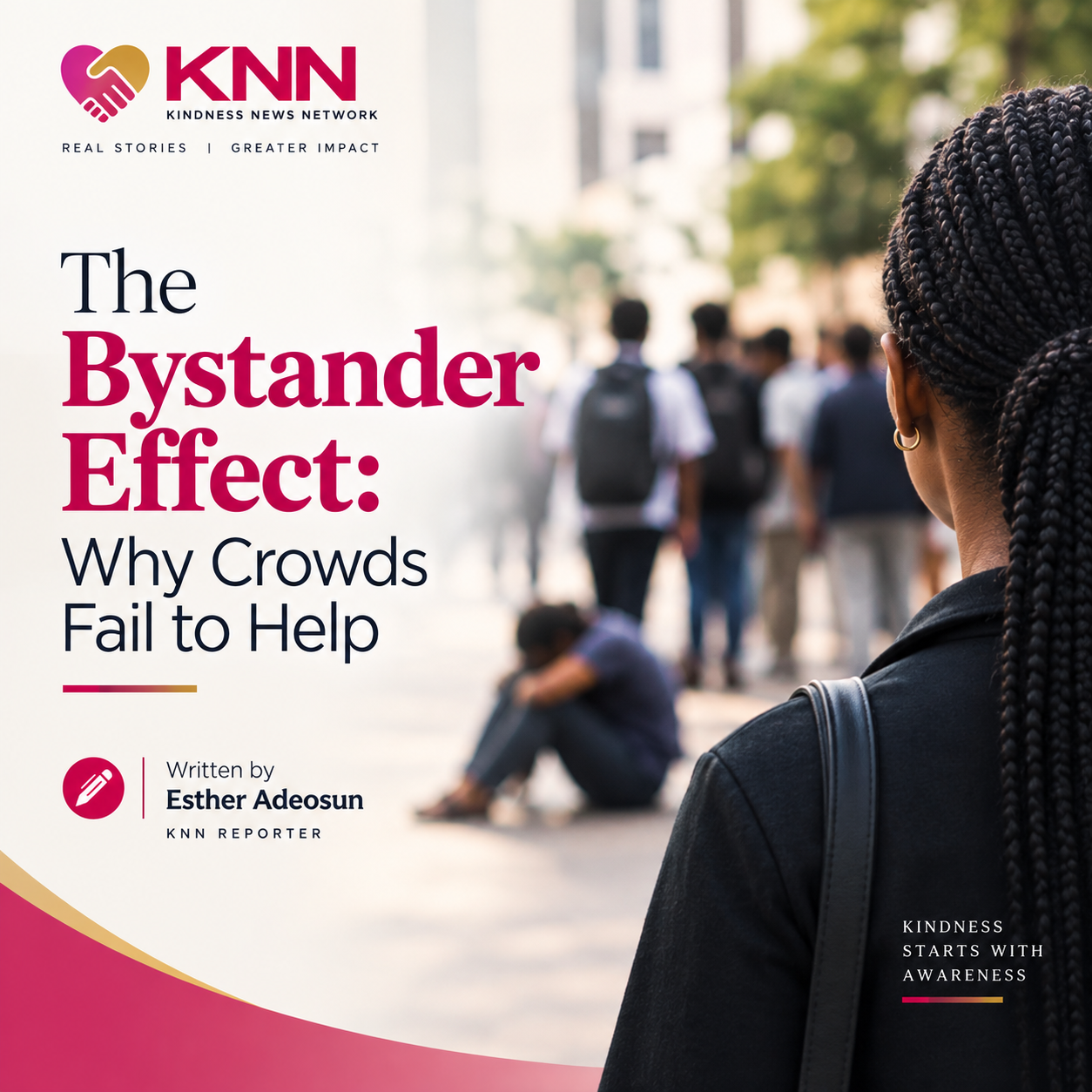
Last week, we looked at a hard question: why we often protect a suffering animal more readily than a suffering stranger. This week, we look at something that makes the answer even more troubling. It is not only that individuals hesitate to help strangers in distress. It is that the more people who are present to witness that distress, the less likely any single one of them becomes to act.
This is not a guess about human nature. It is one of the most consistently replicated findings in psychology, and it has a name: the bystander effect.
Where the idea comes from
The bystander effect was first studied closely after a 1964 case in New York, in which a young woman named Kitty Genovese was murdered outside her apartment while, according to contemporary reporting, numerous neighbours were aware something was happening and few intervened or called for help. The exact details of that case have since been debated and partly revised by historians, but the incident prompted psychologists to ask a question that has held up for sixty years since: why does the presence of other people make individuals less likely to help, not more.
The answer researchers arrived at was not that people in groups are crueler than people alone. It was that groups change the psychology of responsibility itself.
Diffusion of responsibility
The core mechanism is called diffusion of responsibility. When one person witnesses someone in distress alone, the responsibility to act sits entirely with them. There is no one else it could belong together. But when many people witness the same event together, that responsibility quietly splits into fractions. Each person, often without consciously deciding to, assumes that someone else is better positioned to help, has already called for assistance, or will step in a moment from now.
The effect is powerful enough that researchers have found people are sometimes more likely to help a stranger in an empty room than in a crowded one, even when the need is identical. It is not that a crowd makes people indifferent. It is that a crowd makes each person feel less personally responsible for an outcome that, in truth, still depends on someone in that crowd choosing to act.
Social proof and the fear of being wrong
A second mechanism compounds the first. In an ambiguous or frightening situation, people look to others to decide how to interpret what is happening. If everyone else appears calm, uninvolved, or unconcerned, that calm becomes a kind of evidence, suggesting the situation may not be as serious as it looks, or that intervening might be unwelcome or embarrassing.
This is part of what likely happened in the crowd we discussed last week. Once a few people responded to the man’s distress with laughter rather than alarm, that reaction offered a kind of social permission to everyone watching. Laughing became the visible norm. Stepping forward to help would have meant breaking from what the crowd had already, collectively and wordlessly, decided the appropriate response was.
Why this matters more than individual blame
It would be easy, and somewhat comforting, to explain a crowd’s failure to help as evidence that the people in it were simply callous. The research suggests something less comfortable: ordinary people, including people who would describe themselves as caring and would likely help if alone, behave differently once they are part of a group witnessing the same event.
This does not remove responsibility from anyone who watched and did nothing, let alone anyone who laughed. It does mean the problem is bigger than individual character, and that fixing it requires understanding the mechanism rather than only condemning the people caught inside it. A society that wants fewer moments like the one this month has been built around needs to teach people, deliberately, how to override an instinct that group settings quietly encourage.
What breaks the pattern
Researchers who study this have found a few things reliably interrupt the bystander effect. Being asked directly and specifically, rather than left to assume someone else will act, is one. A single person breaking from the crowd’s apparent consensus, by expressing concern or moving to help, is another, because it removes the false impression that inaction is the group’s shared, considered choice. And simply knowing about the bystander effect in advance appears to help; understanding the mechanism makes people measurably more likely to catch themselves deferring responsibility in the moment it happens.
Where this leaves us
None of this explains away what happened this week, and it should not be read as an excuse offered on behalf of the people who watched. But it does explain why good intentions are not, on their own, protection against this failure. Understanding the pull toward silence in a crowd is what makes it possible to resist it.
Next week, we look at what happens when that silence stops being passive and becomes something closer to complicity, the point where watching turns into taking part.
This piece discusses suicide. If you or someone you know is struggling, please reach out. In Nigeria, the SURPIN Helpline offers free, confidential support around the clock, and Mentally Aware Nigeria Initiative (MANI) also provides phone support.