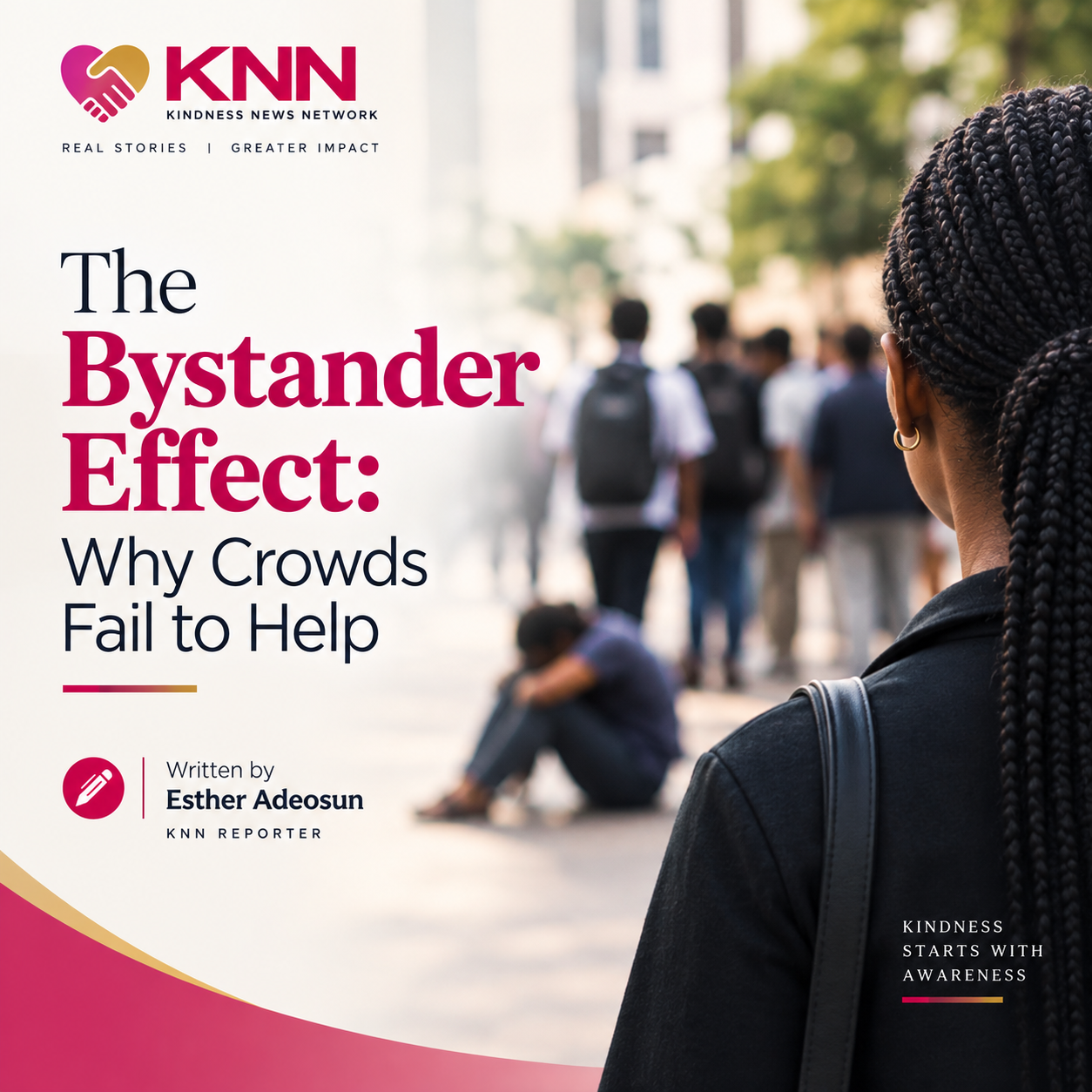

cross this month, we have looked at why people fail to help strangers in visible pain. We looked at the selective nature of compassion, at the psychology that makes crowds slower to act than individuals, and at the harder line between hesitation and cruelty. All of it has been, in different ways, a description of failure. This final piece is about the opposite. What does it actually look like when someone does the thing this whole month has been asking for, and moves.
It is worth saying plainly, before anything else, that moving toward someone else’s pain is rarely dramatic. Most of the accounts of people who intervened in a crisis, whether researchers studying bystander behaviour or witnesses describing what someone else did right, describe something quieter than heroism. They describe a person who simply did not let the moment pass.
It starts with naming what is happening
One of the most consistent findings in research on emergency intervention is that the biggest barrier is not fear of danger. It is uncertainty about whether help is actually needed. People delay because they are not sure whether what they are seeing qualifies as an emergency, and no one wants to overreact to something that turns out to be nothing.
The person who moves is often the person who simply says the situation out loud. Someone here needs help. This is serious. Naming it does two things at once. It ends the private uncertainty for the person who says it, and it interrupts the crowd’s collective wait for someone else to decide the tone. Once one person treats a moment as urgent, it becomes noticeably harder for everyone else to keep treating it as spectacle.
It rarely requires being the expert
A common, understandable fear is not knowing the right thing to do, especially in a crisis involving someone’s mental state, where the stakes feel too high for guesswork. This fear keeps many well-meaning people frozen. But intervention does not usually require expertise. It requires presence.
Calling for help, from emergency services, from a mental health line, from anyone qualified, is itself a complete and valuable action. Staying with a person so they are not left alone with a crowd around them is another. Speaking to them directly, using their situation rather than talking about them as though they cannot hear, is often more powerful than any specific set of words. The goal in the moment is rarely to solve the crisis single-handedly. It is to make sure the person is no longer facing it entirely alone.
It means being willing to be the only one
Nearly every account of someone intervening in a crisis includes a moment where that person was, briefly, the only one doing anything. This is uncomfortable, and it is exactly the discomfort the bystander effect depends on to keep everyone still. Breaking from a crowd’s apparent consensus, even a consensus of silence rather than cruelty, takes a specific kind of willingness: to be visibly out of step with everyone else, for as long as it takes for someone else to follow.
The evidence from research is consistent on what happens next. Once one person acts, others are considerably more likely to join. The first mover does not need to carry the whole weight alone for long. They simply need to be willing to carry it first.
It means treating dignity as non-negotiable
Even in a crisis, how a person is treated matters. Speaking to someone with calm respect, rather than panic or pity, preserves something that is easy to strip away from a person in their worst moment: the sense that they are still being seen as a whole person, not as a scene. This is, in the end, the direct answer to where this month began. The instinct that makes us protective of a suffering animal is, at its core, a recognition of a creature’s vulnerability without judgment attached. Extending that same unjudging recognition to a person in crisis, rather than assumptions about blame or spectacle, is what closes the gap this month has been examining.
Closing the month
We began by asking why a crowd would protect a stranger’s dog more readily than a stranger’s pain. We found part of the answer in how crowds diffuse responsibility, part of it in how watching can curdle into complicity, and we end here, with the plainest possible answer to what should happen instead. Someone has to name what is happening. Someone has to call for help. Someone has to stay. Someone has to be willing to be the only one, for as long as it takes for that to stop being true.
That someone does not have to be extraordinary. They only have to be willing to move before they are certain it is their turn.