
We’ve all been there. Our heart races, and our words come fast. Someone says something wrong, and we’re in a heated argument. We feel the urge to defend ourselves and prove our point.
What if we told you that the most powerful thing you can do in that moment is nothing? The answer lies in a simple pause.
Choosing compassion in heated moments isn’t about being weak. It’s about recognizing the power in those seconds before we respond. We can shift from fighting to understanding, from trying to win to connecting.
Research shows us something interesting about conflict. Most of us try to fix disagreements by explaining why the other person is wrong. But this rarely works. Real change happens when people feel heard and respected.
The work we’re about to explore starts small. It begins with moments between you and another person. Yet, these moments create ripples. They touch your relationships and communities. When we practice compassion, we contribute to something larger than ourselves.
This journey toward choosing compassion is about becoming intentional. It’s about building new habits that feel natural over time. We’ll explore practical steps for real situations with real people. Small shifts can lead to big changes.
Key Takeaways
- Compassion in heated moments comes from pausing between stimulus and response, giving us room to choose understanding over argument
- Most conflicts don’t resolve when someone wins the argument but when all people feel heard and respected
- Choosing compassion requires strength and intentionality, not weakness or surrender
- Small individual moments of compassion ripple outward to create harmony in relationships and communities
- Conflict resolution works best when we focus on understanding perceptions and uncovering interests beneath the surface
- Practical techniques for managing heated moments are learnable skills that improve with practice over time
- Compassion practices start personally but contribute to global peace and harmony
Understanding the Importance of Compassion in Conflict
When disagreements arise, we often see only our side. Research by Linda Babcock and George Loewenstein shows our fairness is shaped by our own views. This makes understanding others hard, leading to many conflicts. Compassion helps bridge this gap, changing how we connect during tough times.
Anger, fear, or hurt can harm our bonds. In these moments, compassion is key. It lets us pause, breathe, and respond wisely, not angrily. Choosing compassion and empathy can lead to real solutions and healing.
What is Compassion?
Compassion is more than feeling sorry for someone. It’s wanting to ease their pain and truly understanding their view, even when we disagree. It’s a strength that takes courage and self-awareness. We must listen deeply, putting aside our own needs.
Compassion is different from pity or enabling. Pity makes us feel superior, while enabling stops growth. Compassion respects the other’s dignity and offers real support. It says, “I see your pain, and I want to help you find your way.”
The Science Behind Compassion
Our brains are made for compassion. Empathy and emotional control activate certain brain areas. Studies show that compassion lowers stress hormones, making kind actions more natural over time.
Compassion also boosts our health. It lowers blood pressure and strengthens our immune system for both the giver and receiver. Using compassion in conflict resolution heals us and others.
- Compassion activates the brain’s reward centers
- Emotional regulation reduces stress hormones
- Compassionate responses improve physical health
- Neural pathways strengthen with repeated compassionate choices
The Impact of Compassion on Relationships
Compassion can truly change relationships. A couple’s arguments stopped when they paused before reacting. By regulating emotions and seeking understanding, they rebuilt trust and closeness.
In workplaces, coworkers solved long-standing issues by focusing on understanding, not blame. Leaders who show empathy create safe spaces where everyone feels heard. This changes how we interact in all our relationships.
Compassion in one relationship can positively impact many. Each act of compassion creates ripples that help build global harmony and understanding.
| What Drives Conflict | Compassionate Response | Result |
|---|---|---|
| Feeling disrespected | Acknowledge worth and validate feelings | Restored dignity and trust |
| Fear of exclusion | Create psychologically safe spaces | Belonging and connection |
| Lack of recognition | Show genuine interest in perspective | Increased confidence and openness |
| Loss of trust | Practice consistent empathy and honesty | Rebuilding and stronger bonds |
Choosing compassion in conflict breaks the cycle of blame and defensiveness. It lets us see the humanity in others. This shift is deeply personal and profound, affecting all our relationships.
Recognizing Heated Moments
We all face moments when emotions get the best of us. The good news is we can learn to spot these moments early. By being more aware of our emotions and practicing mindfulness, we can choose to respond with kindness.
Recognizing heated moments is key to resolving conflicts. It lets us think before we react, avoiding regrets.
Identifying Triggers
Everyone has things that make them angry or upset. These triggers can be anything that makes us feel defensive or scared. Knowing what triggers you is important for controlling your emotions and improving relationships.
Reflect on recent conflicts to find patterns. Do you get upset when criticized or ignored? Are certain topics like money or politics always a source of tension? These are clues to your emotional hot buttons.
Try tracking three recent conflicts to find your triggers. Write down what happened, how you felt, and what triggered your strong reaction. Over time, you’ll see patterns. This builds your mindfulness and helps you catch triggers early.
Emotional Awareness and Its Role
Our bodies give us signals before we lose control. Learning to recognize these signals is powerful. You might feel your chest tighten, your jaw clench, or your voice rise.
Mindfulness helps us notice these signs. When we pause and observe our body’s signals without judgment, we create space. This space is where we can choose to respond with kindness.
- Notice your breathing. Is it shallow or rapid?
- Check your muscles. Are you tense or relaxed?
- Observe your thoughts. Are they racing or focused?
- Feel your emotions. What feeling is strongest right now?
The Benefits of Early Recognition
Recognizing heated moments early gives us choices. We can pause, breathe, and respond with intention. This reduces regret and keeps our relationships strong.
Emotional awareness is a skill we can learn. Each time we recognize a trigger and pause, we get better at managing our emotions. Small victories add up, making our communities calmer and more understanding.
The Art of the Pause: Techniques to Implement
When conflict arises, we need tools to use immediately. The pause isn’t about avoiding issues. It’s about giving our thinking brain time to work. When we feel upset, our emotions take over. A simple pause helps us regain control and respond clearly.
Breathing Exercises
Our breath is a quick way to manage stress. Deliberate breathing activates our calm response. There are several breathing methods that work fast and can be done anywhere.
- The 4-7-8 Breath: Inhale for 4 counts, hold for 7 counts, exhale for 8 counts. Do this three times before responding.
- Box Breathing: Breathe in for 4 counts, hold for 4 counts, exhale for 4 counts, hold for 4 counts. Repeat four times.
- The Centering Breath: Take one deep breath while thinking the word “pause.” This resets your nervous system instantly.
These exercises calm our body’s fight-or-flight response. Nurses and healthcare workers use them daily to stay calm during stressful situations.
Mindful Observation
Mindfulness keeps us in the present moment. Pausing to notice our surroundings helps us avoid angry thoughts. Try this simple practice:
- Name five things you can see in the room
- Name four things you can hear
- Name three things you can touch
- Name two things you can smell
- Name one thing you can taste
This technique takes about two minutes. It stops our anger story and helps us stay calm. Parents and teachers use it to manage tense moments.
Counting to Ten
Counting to ten is a common advice, but it’s often overlooked. Make it more effective by adding gratitude. As you count, think of something you appreciate about the other person or situation.
This approach transforms the exercise. Instead of just waiting out anger, we build emotional regulation through appreciation. Managers and family members use it during conflicts.
| Technique | Time Needed | Best For | Results |
|---|---|---|---|
| Breathing Exercises | 2-3 minutes | Immediate stress management | Calms nervous system |
| Mindful Observation | 2-5 minutes | Grounding in the present | Shifts focus from anger |
| Counting with Gratitude | 1-2 minutes | Quick emotional reset | Builds perspective |
These techniques may feel awkward at first. But with practice, they become natural. We’re not avoiding conflict; we’re creating space for real dialogue. Mastering self-control helps build communities where people respond thoughtfully. This change starts with us and affects everyone we meet.
Communicating with Kindness
Learning to pause is just the start. How we speak matters just as much as when we listen. Our words shape every interaction. By switching to kind dialogue, we understand each other better.
This section shows us how to speak kindly, even when topics are tough. These methods boost empathy and turn conflicts into chances to connect.
Choosing Your Words Wisely
The words we pick in tough talks can either unite or divide. A key change is how we share our feelings. Instead of saying “You never listen,” say “I feel unheard when interrupted.” This change turns accusations into honest expressions.
We can use a simple formula to share our feelings:
- I feel [emotion]
- When [specific situation happens]
- Because [the impact on me]
Avoiding words like “always” and “never” helps keep talks open. Talking about our own feelings instead of judging others makes them more open. Being specific and factual helps protect everyone’s dignity while addressing real issues.
Active Listening Techniques
Good communication means listening as much as we talk. Our empathy grows when we really listen to others. Here are steps to improve right now:
- Maintain eye contact to show genuine interest
- Put away phones and distractions
- Stop planning our response while they speak
- Notice their body language and tone of voice
- Ask open-ended questions like “Help me understand…” or “What matters most to you about this?”
Practicing active listening without quick fixes makes people feel heard. This builds trust and strengthens our ability to resolve conflicts.
Paraphrasing for Clarity
Paraphrasing means reflecting back what we’ve heard. We might say “What I’m hearing is…” or “It sounds like you’re feeling…” This shows we care about their view.
Paraphrasing is not agreement—it’s acknowledgment. This is key. When a neighbor feels heard, even if we disagree, we move toward solutions. This simple act prevents issues from escalating.
| Communication Approach | Effect on Conflict Resolution | Impact on Empathy |
|---|---|---|
| Accusatory statements (“You always…”) | Increases defensiveness and tension | Reduces connection and understanding |
| “I” statements with feelings | Opens dialogue and collaboration | Builds genuine empathy and respect |
| Interrupting and planning responses | Prevents real problem-solving | Blocks authentic connection |
| Active listening and paraphrasing | Resolves issues through understanding | Strengthens mutual respect and care |
Kind communication doesn’t mean avoiding tough talks. It means tackling challenges with respect. Every kind conversation we have makes our families, workplaces, and communities stronger. When we communicate with kindness, we create a more compassionate world for all.
Practical Conflict Resolution Strategies
When disagreements arise, we have a choice. We can either fight to win or work together to find solutions. Conflict resolution is about finding creative ways to meet everyone’s needs. By improving our communication and empathy, we turn arguments into chances for growth.
These strategies show that both sides can win. This approach strengthens relationships and brings lasting peace to our homes, workplaces, and communities.
Collaborative Problem Solving
True conflict resolution means growing the pie, not just dividing it. When people disagree, they often focus on what they want. Real breakthroughs come from understanding each other’s deeper needs.
Here’s a five-step process we can all use:
- Define the problem from both perspectives
- Identify each person’s underlying needs, not just their positions
- Brainstorm solutions together without judgment
- Evaluate options against both parties’ needs
- Choose a solution and agree on how to implement it
Imagine two coworkers fighting over a shared office. One needs quiet for focus work. The other wants collaboration. They created a flexible schedule. This way, both got what they needed by working together.
Finding Common Ground
Every conflict has hidden agreement. We often focus too much on our differences. Starting a difficult conversation by naming common ground changes everything.
Even in intense disagreements, consider what both sides want:
- Both want to feel respected
- Both care about the relationship
- Both desire a real resolution
- Both want what’s best for shared interests
When divorced parents started by naming their shared commitment to their children, tension dropped. They became partners with a shared goal, not enemies. This simple shift opened up new solutions and deeper empathy between them.
| Communication Approach | What Happens | Outcome |
|---|---|---|
| Adversarial (“You vs. Me”) | Both sides protect their position and attack the other | Damaged relationship, temporary solutions |
| Collaborative (“Us Together”) | Both sides explore needs and brainstorm together | Stronger relationship, lasting solutions |
| Avoidant (Ignoring the issue) | Problems build resentment silently | Relationship deteriorates, issues explode later |
The Role of Humor in Conflict Resolution
Laughter can heal when used wisely. The key is knowing the difference between humor that unites and humor that wounds. Real humor connects us by acknowledging our shared messiness. It should never mock or dismiss.
One couple found a powerful way to handle their arguments. They created a playful “conflict monster” character. When tension rises, they laugh at the pattern together, not at each other. The humor works because both feel heard and respected first.
Humor becomes a bridge when these conditions exist:
- Both people feel heard and validated
- The joke doesn’t target or mock either person
- It lightens tension without dismissing real concerns
- It reminds us of our shared humanity
Effective conflict resolution makes both sides feel like winners. Our relationships grow stronger, not weaker. Each disagreement we handle with these strategies is practice for building more collaborative communities. We’re not just solving problems in our own lives. We’re practicing the skills our world needs for genuine peace and understanding.
Real-World Examples of Compassion in Action
Compassion changes conflicts every day. People choose understanding over winning. These stories show empathy and communication skills create lasting change.
Community Intervention Stories
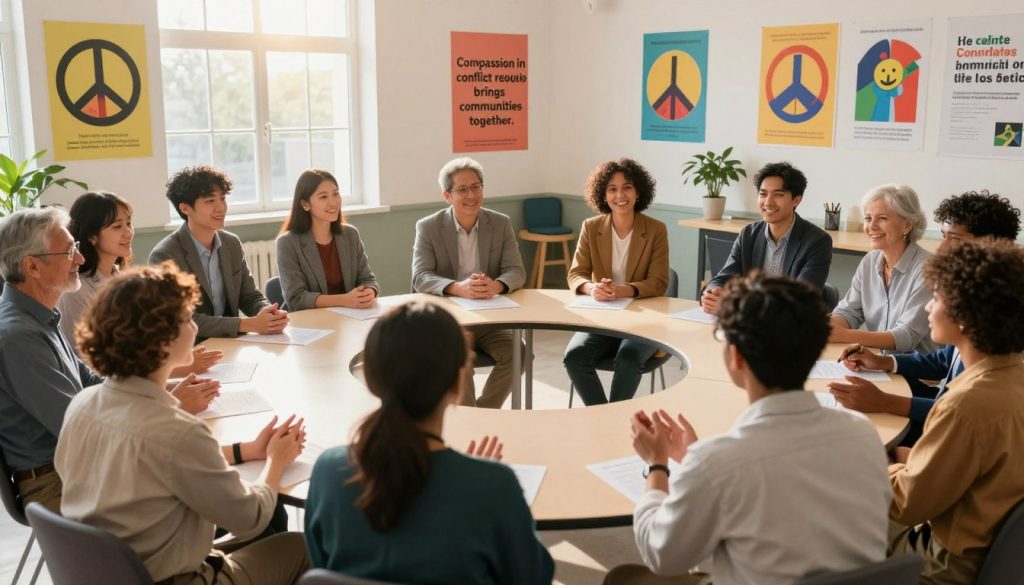
In Portland, Oregon, a neighborhood was divided over a development project. Residents had different opinions. One resident organized listening circles where everyone shared their hopes and fears.
This simple act of empathy revealed that both groups cared about the community. They found a compromise that allowed for growth while preserving what was important.
A Texas restorative justice program helped a teenager who vandalized a business. Instead of punishment, they focused on understanding and making things right. The teen received mentorship and made amends, changing his life path. The business owner saw genuine remorse and gained a meaningful relationship.
In an apartment building, neighbors complained about noise. A mediator helped them understand each other’s needs. They created a community agreement that worked for everyone, turning conflict into cooperation.
Workplace Conflict Resolution
Two departments at a tech company were in constant conflict. A facilitated session revealed they both wanted the same goal. They just never communicated their strategies. Once leaders showed empathy and communication skills, they worked together.
At a hospital, a nurse and doctor disagreed about patient care. Active listening exercises showed they both wanted the best for the patient. They found they just needed to share information. Improved communication solved the problem.
A small business owner faced an employee’s lateness. Instead of warnings, the owner asked with compassion, “What’s happening for you?” The conversation revealed a childcare crisis. A flexible schedule followed, improving both the employee’s life and workplace productivity.
Family Dynamics and Compassionate Responses
A family was fractured over care decisions for an aging parent. Tensions were high. A mediator helped everyone express their fears and values. Empathy guided the discussion, leading to a care plan everyone supported.
Parents struggling with their adult child found the power of listening without advice. When they showed genuine empathy, their relationship healed. Reflecting back what they heard created understanding they never had before.
Siblings divided over an inheritance fought about money. They addressed deeper feelings with compassion. They resolved the financial dispute and restored their relationship.
| Setting | The Challenge | Compassionate Approach | Outcome |
|---|---|---|---|
| Portland Neighborhood | Development project division | Listening circles with empathy | Compromise addressing both concerns |
| Texas Community | Property vandalism | Restorative justice with mentorship | Restitution and transformed lives |
| Apartment Building | Noise complaints between neighbors | Mediation building understanding | Community agreement benefiting all |
| Tech Company | Departmental conflict | Facilitated communication session | Shared goals and collaboration |
| Hospital | Nurse-doctor disagreement | Active listening exercises | Unified patient care approach |
| Small Business | Employee lateness | Compassionate conversation | Flexible schedule and improved performance |
| Family Care Decision | Aging parent care disagreement | Mediated family meeting | Unified care plan with family strength |
| Family Relationship | Parent-adult child tension | Empathetic listening without advice | Healed relationship and understanding |
| Sibling Inheritance | Financial and fairness dispute | Addressing underlying emotions | Resolved finances and restored bond |
Something powerful is seen in all these examples. Choosing compassion over winning transforms conflicts and strengthens relationships. Using empathy and communication skills in conflict resolution creates positive change.
These stories show compassion is not weakness. It is practical wisdom that works in real life. Our communities, workplaces, and families thrive when we pause, listen, and choose understanding.
Optimizing Personal Health Through Compassion
We can’t give what we don’t have. Taking care of ourselves is not selfish. It’s the base for showing real compassion to others. When we treat ourselves with kindness, we grow strong enough to help others.
This section looks at how self-compassion is key to lasting wellness. It helps us make a positive impact on the world.
Self-Compassion Practices
Self-compassion is about being kind to ourselves like we are to a friend. Research by psychologist Kristin Neff shows it has three main parts. These are self-kindness, understanding we’re all human, and being aware of our feelings.
Here are some ways to practice self-compassion:
- Put your hand on your heart when stressed and be kind to yourself
- Write a kind letter to yourself about a time you felt like you failed
- Notice how you talk to yourself and if it’s how you’d talk to a friend
- Say “I’m struggling right now, and that’s okay” when things get tough
Self-compassion helps manage stress. It changes our nervous system from being in threat mode to care mode. This lowers stress hormones and helps us handle emotions better.
The Connection Between Mental Health and Compassion
There’s a strong link between mental health and compassion. Self-compassion reduces anxiety and depression and builds resilience. Studies show it helps us handle tough situations better.
Self-criticism makes us stressed. But self-compassion makes us feel safe and well. It’s not just good for our feelings; it’s good for our body too.
When we’re kind to ourselves, we can be kind to others. We have the emotional strength to support those around us.
Healthy Boundaries in Relationships
Compassion doesn’t mean saying yes to everything. It means setting boundaries to protect ourselves and help others grow. Healthy boundaries are like guidelines, not walls.
Setting clear expectations helps avoid misunderstandings and conflict. When we say no with kindness, we teach others about self-control and emotional balance:
| Boundary Type | Example | Benefit |
|---|---|---|
| Emotional Boundaries | “I’m listening, and I need to protect my own energy” | Prevents emotional exhaustion |
| Time Boundaries | “I can help on Tuesday afternoon” | Creates predictability and respect |
| Physical Boundaries | “I need personal space right now” | Maintains comfort and safety |
| Professional Boundaries | “Work conversations stay at work” | Prevents burnout and maintains balance |
When we care for ourselves with compassion, we become sources of kindness. Self-compassion is not just about preparing to help others. It’s the start of creating harmony in our relationships and communities.
Supporting Neighbors with Kindness
Our neighborhoods are the base of our world. When we show kindness locally, we make a big impact. By helping our neighbors, we turn ordinary places into caring communities. This section shows how small acts of kindness can make a big difference.
Building Community Through Compassion
Compassion starts with seeing the people around us. Many places feel cold because people don’t know each other. But when we choose kindness, we change that.
In Denver, neighbors started a “front porch Friday” tradition. They just sat outside, ready to talk. This simple act made their neighborhood feel like a real community.
Good communication is key to connecting. When we listen well and show empathy, neighbors feel valued. In Kansas, a building used a bulletin board for solving problems. It cut down complaints by sixty percent.
Acts of Kindness in Daily Life
Small actions can lead to big changes. We don’t need grand gestures to help our neighbors. Just being kind every day can make a big difference.
- Bring in a neighbor’s trash bins on collection day
- Shovel an elderly neighbor’s sidewalk during winter storms
- Offer to pick up groceries for someone who’s ill
- Organize a neighborhood potluck or block party
- Start a Little Free Library filled with books
- Create a neighborhood directory so people can connect
- Check on neighbors during extreme weather events
- Smile and greet people by name consistently
In Oklahoma, a retired neighbor learned everyone’s name on his block. This simple act of kindness made his neighborhood safer and happier. His effort showed how important it is to care about others.
Volunteering and Its Impact
Volunteering helps us reach out beyond our neighbors. It strengthens the bonds that hold communities together.
| Volunteer Opportunity | Community Benefit | Volunteer Benefit |
|---|---|---|
| Food Bank Service | Ensures food security for families in need | Increased sense of purpose and connection |
| Student Tutoring | Improved educational outcomes for youth | Greater life satisfaction and fulfillment |
| Nursing Home Visits | Reduced isolation for seniors | Reduced depression and increased wellbeing |
| Community Mediation Programs | Peaceful conflict resolution without courts | Development of valuable communication skills |
| Neighborhood Associations | Stronger community organization and advocacy | Extended lifespan and social engagement |
Community mediation services offer free help for neighbors to solve problems. These programs turn conflicts into chances to build stronger bonds. The mediators bring kindness and understanding to the talks, helping people find common ground.
Studies show volunteering is good for both the giver and receiver. It makes people happier, less depressed, and even live longer. Helping our neighbors through volunteering is good for us too.
Peace starts in our neighborhoods, and neighborhoods start with kindness. Every kind act we do with our neighbors is a step towards global peace. When we show real compassion and empathy, we’re not just helping our neighbors. We’re helping the world become a more harmonious place, one neighborhood at a time.
Caring for the Planet with Compassion
Compassion is more than just helping people. It’s also about caring for our planet and all living things. By making sustainable choices, we show kindness to future generations and to the environment. Every choice we make has a positive impact on the world.
Dealing with environmental issues requires the same skills as solving conflicts. Finding common ground helps us come up with creative solutions. Working together, we can achieve our environmental goals.
Sustainable Choices as Acts of Kindness
Even small actions can make a big difference. The Martinez family, for example, made one sustainable change each month. They used reusable bags, bought local foods, and reduced waste. These simple steps showed their care for the future.
These actions didn’t just help the planet. They also saved money and made their lives simpler. It gave them a sense of purpose and connection to something bigger.
- Carry reusable bags, bottles, and containers
- Choose local and seasonal foods
- Plan meals to reduce food waste
- Walk, bike, or use public transit
- Reduce energy consumption mindfully
- Support businesses with sustainable practices

Community Clean-ups
Working together to clean up shared spaces is beautiful. It brings people together who might not meet normally. In Austin, a monthly river clean-up unites neighbors. In Chicago, a local park was transformed into a community space.
Starting a clean-up in your area is easy:
- Find a place that needs cleaning
- Choose a date and time
- Get the right supplies
- Invite people through social media
- Have a celebration afterwards
Advocacy for Environmental Justice
Compassion means recognizing that environmental harm affects the most vulnerable. Pollution and climate change hit marginalized communities hard. Our empathy must lead to action.
We can make a difference by contacting our representatives, supporting environmental justice groups, and educating others. Making conscious purchasing choices and amplifying the voices of affected communities also helps.
In one neighborhood, a coalition fought to close a polluting facility. This improved health for residents. It shows that our actions can lead to real change.
Caring for the planet and people go hand in hand. Every sustainable choice is a kind act for the future. Advocacy is a moment of compassion that can lead to global harmony.
Fostering Global Harmony Through Compassion
Choosing compassion in heated moments is more than solving a single conflict. It’s part of a global shift toward understanding and peace. Our kindness ripples out, touching lives in ways we might never see. By focusing on communication and compassion, we build a world of harmony.
Practicing empathy in conflict resolution shows us a new way to live together. Our families learn from our choices. Communities heal, and workplaces become more cooperative. These small acts add up, changing how societies handle disagreements.
The Ripple Effect of Kindness
Studies show kindness spreads when we see it. When we respond with empathy, we inspire others to do the same. One act of kindness can start a chain of goodness that goes far beyond the moment.
Think about how a teacher’s patience can change lives. A teacher’s kindness can inspire a student to grow up and help others. This kindness grows, touching lives across generations.
- One compassionate pause prevents unnecessary conflict escalation
- Families experiencing peaceful resolution model healthy skills for children
- Children grow up practicing empathy in their own relationships
- Communities become safer and more connected
- Generational patterns shift toward understanding instead of blame
Global Movements Focused on Compassion
Across the globe, movements show compassion can lead to real change. The Charter for Compassion unites communities around empathy. Restorative justice focuses on healing, not punishment, in criminal systems.
In Northern Ireland, peace talks succeeded with skilled mediators. In South Africa, restorative justice helped communities heal. Cities worldwide are adopting policies that reduce suffering. Schools in over 60 countries teach empathy and meditation.
| Global Movement | Focus Area | Impact on Conflict Resolution | Empathy-Based Approach |
|---|---|---|---|
| Charter for Compassion | Civic and organizational life | Transforms institutional cultures | Centers compassion in decision-making |
| Restorative Justice Programs | Criminal justice systems | Reduces recidivism through healing | Focuses on victim and offender understanding |
| Compassionate Cities Movement | Urban policy and practice | Builds safer, more connected communities | Prioritizes wellbeing over punishment |
| Global Mindfulness Schools | Youth education | Develops young people’s conflict resolution abilities | Teaches empathy and emotional awareness |
Personal Actions That Lead to Bigger Changes
Your personal practice of compassion is key to global movements. Pausing before anger is more than managing a moment. It’s building a skill for empathy and communication.
Here’s how personal compassion leads to global change:
- Personal pause moments create peaceful resolution in daily conflicts
- Improved personal relationships strengthen families
- Healthy families build stronger communities
- Strong communities develop more compassionate institutions
- Compassionate institutions shift cultural values toward understanding
- Cultural shifts reduce violence and increase cooperation
- Global cooperation builds lasting peace and harmony
A grandmother’s compassion can influence her children. Their children will grow up practicing empathy. This kindness spreads through families and communities.
We’re at a moment where global harmony depends on our choices. Every time we choose empathy, we contribute to a better world. We’re not waiting for others to change. We’re creating a kinder world through our actions.
“In a single generation, we could create a world where compassion is the default response to conflict, where understanding is valued over winning, and where peace becomes our natural way of being together.”
The power to change our world is in our hands and hearts. It’s in the pause we take before our next response.
Kindness Challenge: Your Actionable Step Today
We’ve explored the power of pausing and the impact of choosing compassion. Now, it’s time to take action. Studies show that most conflicts end when people feel heard and respected. This section offers ways to practice empathy and self-control today.
Simple Acts to Spread Kindness
You don’t need perfect moments to spread kindness. Small actions can change the world. Send a text to someone you’ve been meaning to reach out to and say thank you.
Before you respond in a tense moment, take three deep breaths. Ask a family member or colleague how they’re doing and listen without interrupting. These small acts can make a big difference.
Do something kind for a neighbor or make an eco-friendly choice. Write a kind note to yourself or reach out to someone you’ve had conflict with. The act itself is less important than your intention and follow-through.
Encouraging Compassion in Yourself and Others
Building empathy takes daily effort and self-control. Set reminders to pause before reacting. Keep a journal to track moments of kindness.
Share your experiences with friends and family. Celebrate when you see others being kind. Use self-compassion when you make mistakes. Online communities support daily kindness challenges.
Committing to One Kind Act Today
Before the day ends, pause in one tense moment. It could be frustration in traffic or annoyance with a family member. Take deep breaths and try to understand the other person’s perspective.
Respond with kindness instead of anger. Notice the effects on your body and relationships. Share your experience or write about it. This small pause can contribute to global harmony.
Make this commitment: “Today, I will pause in one tense moment and choose compassion. I know this small act will improve my well-being and relationships, and help create a more harmonious world.” Every pause and every kind choice matters.
The power to create a more compassionate world is within you. It’s in the pause between what happens and how you respond. Choose compassion today and watch the positive effects spread far and wide.